All posts
At Implant Pathway, we spend a lot of time talking about growth—clinical growth, professional growth, and personal growth. But growth doesn’t always mean doing more. Sometimes it means doing better. Fewer procedures. Higher impact. More fulfillment.
That philosophy is embodied perfectly by one of our longtime educators and mentors, Andrew Currie, a general dentist based in Atlanta who has spent the last 15 years reshaping what his career—and the careers of hundreds of other dentists—can look like.
This is the story of how we move from fillings to full arches, why advanced implant dentistry changes lives (for patients and clinicians), and how education, fundamentals, and community make all the difference.
Seeing Dentistry Differently from the Start
Dr. Currie’s journey into implant dentistry began earlier than most. While he was in dental school at the University of Louisville, he happened to be part of the very first class to receive formal implant education. That detail may sound small, but it planted a seed that would shape everything that came next.
Like many dental students, he learned the foundations—fillings, crowns, partial dentures. Important work, absolutely. But implants were different. They were more dynamic. More technical. More transformative.
It wasn’t just clinically interesting; it was energizing. And that spark never went away.
At the same time, Dr. Currie was thinking bigger-picture. He recognized something many dentists don’t fully consider early on: demographics matter. The baby boomer generation was entering the years of life when tooth loss accelerates—and they were one of the most financially successful generations in history. The need for advanced tooth replacement wasn’t coming someday. It was already here.
What started as forward-thinking quickly became a calling. Once he truly stepped into implant dentistry, there was no going back.
Why Implants Change Lives (and Fillings Usually Don’t)
We want to be clear: restorative dentistry matters. Fillings, crowns, and endo are essential parts of patient care. But there’s an emotional truth most dentists feel deep down—it’s hard to truly change someone’s life with a filling.
Implants are different.
Implants restore chewing. Confidence. Comfort. Identity. They give people their lives back in a way few other procedures can. And when you see that transformation over and over again, it changes how you see your role as a clinician.
That’s what pulled Dr. Currie fully into implant dentistry. He wanted to work at a level where the impact was undeniable—where patients didn’t just leave “fixed,” but grateful.
Finding a Home at Implant Pathway
Dr. Currie didn’t seek out Implant Pathway—it found him.
Through his work teaching with BioHorizons, he was introduced to Justin Moody, the founder of Implant Pathway. Their first meeting wasn’t in a boardroom or a lecture hall. It was over dinner. And almost immediately, there was alignment.
Justin shared a philosophy that resonated deeply with us and with Dr. Currie:
- We don’t allow egos.
- We don’t hire people we wouldn’t trust with our own families.
- And we don’t build communities we wouldn’t want to spend time in.
That mindset is the backbone of Implant Pathway. We’re not interested in hierarchy or posturing. We’re interested in lifting each other up. There’s no scarcity mentality here—no guarding of secrets, no fear of competition. There’s more than enough opportunity to go around.
That culture is what makes Implant Pathway feel less like a course provider and more like a tribe.
Thinking in 2025 Dentistry, Not 1860 Dentistry
One of the messages Dr. Currie emphasizes most in our courses is this:
Dentists owe it to patients to think at the highest level dentistry can offer today.
A perfect example is the removable partial denture. If you look at one from the 1860s and compare it to one made today, the truth is uncomfortable—they’re not that different. Same basic design. Same limitations. Same compromises.
Now compare that to what’s possible with modern implant dentistry.
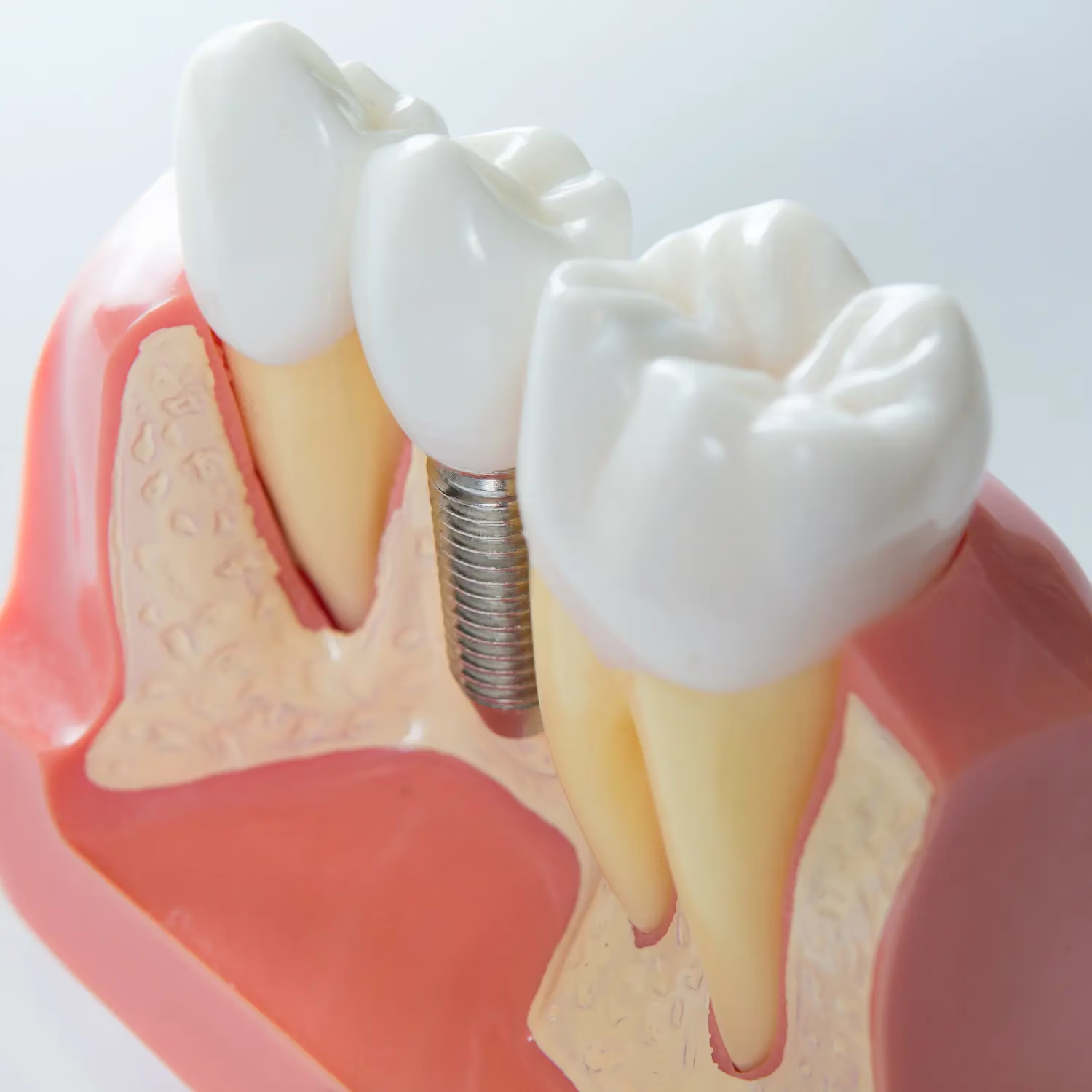
A patient missing their upper back teeth doesn’t have to live with a partial denture anymore. With bilateral sinus lifts and implant-supported bridges, they can chew normally again. They can feel like themselves again.
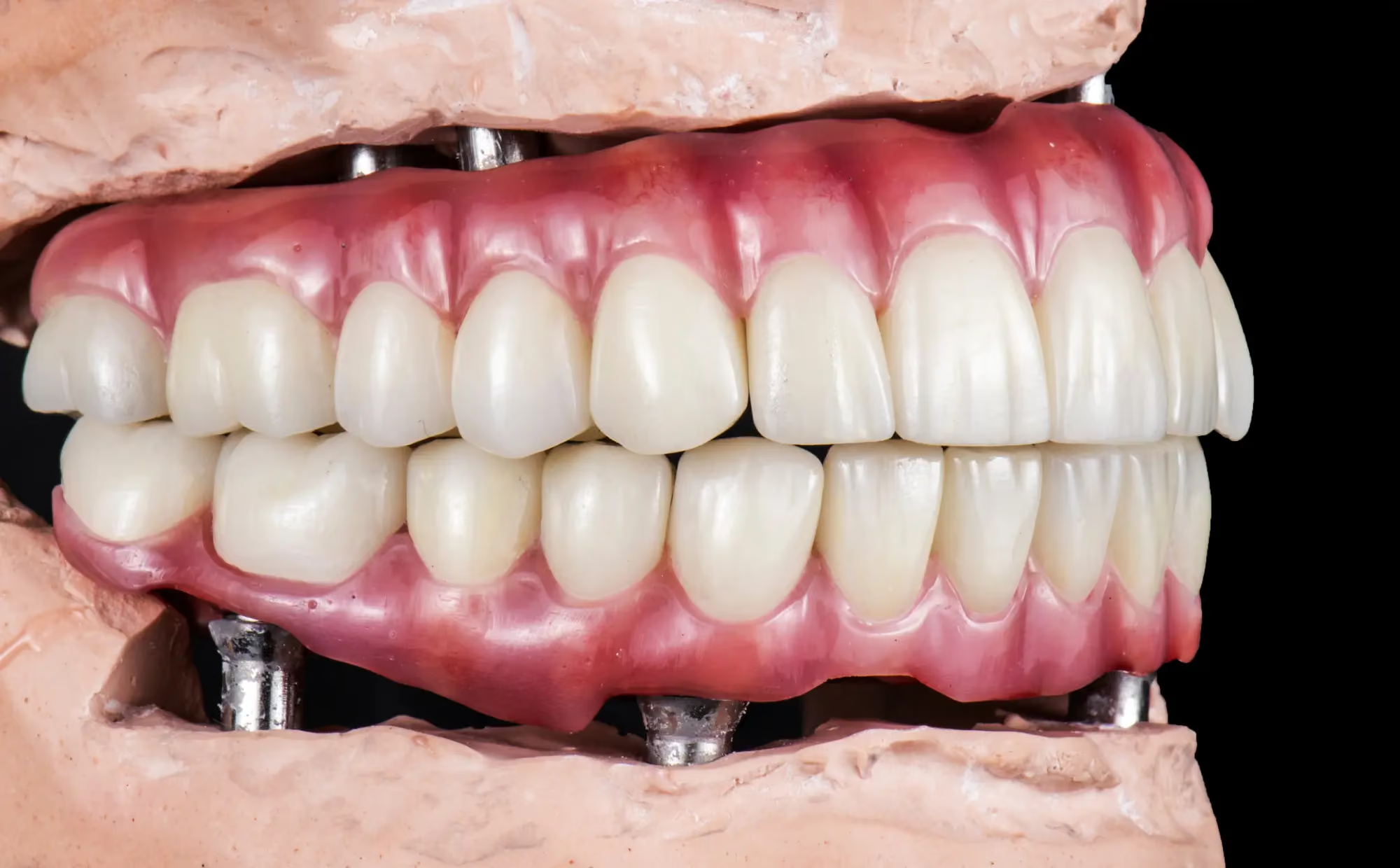
Even an implant-retained overdenture is worlds apart from 1800s dentistry. And a fixed bridge or full-arch restoration? That’s as close as we can get to giving someone their natural teeth back.
Whether or not a dentist personally offers these treatments, we believe there’s an ethical obligation to tell patients what’s possible.
Sinus Lifts: The Most Misunderstood Procedure in Dentistry
Few procedures are as misunderstood—or unfairly feared—as sinus lifts.
In dental school, the sinus is often treated like a danger zone. Touch it and everything goes wrong. Lawsuits. Failures. Disaster. That fear sticks with dentists for years.
But here’s the reality we see every day:
Sinus lifts are one of the most predictable and successful bone grafting procedures in dentistry.
The lateral wall sinus lift, in particular, is considered the gold standard. Unlike vertical (crestal) approaches, it’s not a blind procedure. You can see what you’re doing. You can control the space. You can graft the volume you actually need.
With a lateral approach, we’re not limited to gaining three or four millimeters of bone and hoping for the best. We can reliably create enough bone to support long, stable implants—often 10, 12, even 15 millimeters when appropriate.
That control is what drives long-term success.
A Case That Changed Everything
One of Dr. Currie’s earliest sinus lift cases remains one of the most meaningful of his career—and it perfectly illustrates why we do what we do.
The patient had been wearing complete dentures for 25 years. Over time, her bone had resorbed so severely that her dentures had been relined again and again, becoming thick, unstable, and painful. Her upper jaw had virtually no ridge left. Her lower jaw had resorbed to what we call a “chin strap,” with nerves sitting right at the crest.
Eating hurt. Wearing dentures hurt. Living with her mouth hurt.
At the time, she’d been told—repeatedly—that nothing else was possible.
Dr. Currie took a different approach.
He performed bilateral sinus lifts, placed implants in both arches, and restored her with bar-supported overdentures. The transformation was immediate and dramatic. Her teeth were stable. She could chew again. She could smile again.
Fifteen years later, she tracked him down—not because something failed, but because everything was still working. She simply needed a new denture. The implants were rock-solid.
That’s what sinus lifts make possible.
Why Sinus Lifts Differentiate Dentists
Many dentists place implants. Far fewer place implants and perform sinus lifts.
That distinction matters.
The most commonly lost teeth are the upper posterior teeth—the very teeth most likely to require sinus augmentation. If a dentist can’t perform sinus lifts, patients get referred out. And once a patient leaves, they often don’t come back.
By learning sinus lifts, clinicians keep patients in-house, offer better solutions, and build trust. More importantly, they stop limiting care based on fear rather than capability.
And the truth is, most dentists already have the skills needed. If you can place implants, extract wisdom teeth, or perform guided bone regeneration, sinus lifts are well within reach.
Complications Are Part of Surgery—Not a Failure
One of the most powerful mindset shifts we teach is this:
The tear is coming. Embrace it.
The Schneiderian membrane inside the sinus is delicate. Sometimes it tears—even in the hands of the most experienced surgeons. That’s not a complication; it’s part of the procedure.
The key isn’t avoiding tears at all costs. The key is knowing how to manage them calmly and predictably. Once that fear disappears, confidence skyrockets.
We don’t separate “complication management” from technique. It’s woven into everything we teach. Because surgery isn’t about perfection—it’s about preparation.
Fundamentals Matter More Than Fancy Techniques
Dr. Currie often compares surgery to cooking. Give eight people the same ingredients, and you’ll get eight different dishes.
The same is true in dentistry.
Once you master the fundamentals—flap design, soft tissue management, bone handling, suturing—you can rearrange those skills to handle almost any case. Implants. Bone grafts. Sinus lifts. Full arches.
Complexity doesn’t come from doing more steps. It comes from rearranging fundamentals intelligently.
That’s why growth accelerates so quickly once dentists commit to surgery. Each new procedure isn’t a leap—it’s a small step built on the same foundation.
From Fillings to Fewer, Better Days
One of the biggest misconceptions we hear is that adding implants will overwhelm a practice.
In reality, it does the opposite.
One implant often produces the same revenue as ten fillings. And it usually takes less time. Instead of 20 chaotic appointments, you have two focused ones. Fewer setups. Less burnout. Higher morale.
Assistants love it. Doctors love it. Patients feel the difference.
Implant dentistry doesn’t cram more into your day—it frees your day up.
Digital Dentistry and 3D Printing: The Silent Game-Changer
Digital workflows and 3D printing are another area where we see immediate returns. From surgical guides to denture duplication, the technology reduces lab fees, shortens timelines, and increases control.
A workflow that once took six weeks and hundreds of dollars can now happen in a single day for a few dollars in resin. Patients are amazed. Teams are empowered. Practices become more efficient overnight.
This is modern dentistry—and it’s accessible right now.
Full Arches and the Power of One New Skill
Learning just one additional procedure can transform a practice.
A partial denture might be a $2,500 solution. An implant-supported overdenture or full arch can be $15,000–$25,000. That difference isn’t about money—it’s about outcomes.
One full-arch case can pay for an entire course. Everything after that is growth—financially, clinically, and personally.
Education Is an Investment, Not an Expense
Yes, high-level education costs money. But when used even once, it often pays for itself immediately.
Dentists who take Implant Pathway courses almost always implement what they learn. And once they do, momentum builds quickly. Confidence grows. Cases get bigger. Work gets more rewarding.
The real risk isn’t investing in yourself.
The real risk is staying stuck.
A Community That Actually Shows Up
What truly sets Implant Pathway apart is the community.
Our mentors give out their phone numbers—and mean it. Alumni text us photos of cases they’re proud of. We celebrate wins together. We troubleshoot challenges together.
At our symposiums, you can’t tell who’s a mentor and who’s an attendee. That’s intentional. We’re equals. We’re colleagues. We’re here to grow together.
Final Thoughts: Raising Trajectories, One Dentist at a Time
Moving from fillings to full arches isn’t about abandoning general dentistry. It’s about elevating it.
When dentists grow, patients win. When clinicians think bigger, care gets better. And when education is paired with humility, fundamentals, and community, the impact compounds.
That’s why we do what we do at Implant Pathway.
If you’re ready to think differently—about dentistry, about your career, about what’s possible—we’re here to help.
(888) 309-2423
National education. Real-world results.
Let’s raise the trajectory together.